|
Step 3: Assess Your Costs and Prices After determining which of their customer needs will be satisfied, distributors must evaluate the cost / value relationship of delivering their services to different levels of customers. The goal of this step is to help the distributor:
- Establish a flexible pricing strategy that optimizes profits for different levels of customer value
- Understand and determine the costs to serve diverse customer needs
All customers are not created equal! This means that customers are not only different in their requirements for service, but they also differ greatly in their value (financial worth) to a distributor's business. For example, an occasional customer who focuses on price and product availability but requires no support has a different cost / value relationship than a long-term account that requires a broad assortment of high-value services. This multi-level assortment of distributor services and customer significance effectively lends itself to some type of tiered approach to service offerings and pricing strategy.
Pricing Considerations
When it comes to a pricing strategy that equitably reflects the cost and benefits of providing extended value services, most distributors hope their current gross margin on product sales is sufficient to cover the added cost of service and yield a small profit. However, distributors that expend the effort to evaluate their costs to provide "real customer value contributions" should also extend their analysis to include a review of their current pricing strategy.
The starting point for your development of a value pricing strategy should be with your customers' preference and your current pricing method(s). Another strong consideration must be the compatibility of the pricing method with your company's cost accounting and billing system. Since these elements will vary by individual distributor, the most appropriate advice for a quick solution would be to use your current pricing methodology (i.e. typical examples include bundling in the gross margin or a cost plus approach). However, this pricing approach must be adapted to permit a tiered service offering (Basic and Extended Value) as discussed earlier in Step 2. While there are no absolutes when it comes to establishing "the right way" to price distributor value contributions, the absolutely wrong solution is to ignore the issue!
What Cost Evaluation Methods Are Available?
Distributors have several viable options for determining the cost of serving their customers. Depending upon the availability of cost data, analysis time, personnel and the desired accuracy of the results, any of the six methods shown in the adjacent slide will work. Each of the first three methods,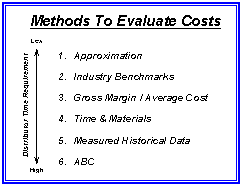
Approximation - Industry Benchmarks - Gross Margin/Avg. Cost
is relatively simple to use and can provide a reasonable estimate of cost. However, it is important to recognize that all three of these methods are variations of estimates or averages, and they should be applied with care and in situations where precision is not required.
In addition to the three simple methods for cost estimation, there are three other approaches that may be appropriate when the distributor requires more accuracy. These include:
Time and Materials - Measured Historical Data - Activity Based Costing (ABC)
Often, the service cost being evaluated can only be determined through a more intensive study of direct and indirect labor and materials costs. For example, Engineering, Design, and Assembly services, etc. are a few of the many extended value services that are most effectively evaluated through the Time and Materials or Measured Historical Data approaches.
The most intensive and broadly useful method of cost estimation is Activity Based Costing (ABC). ABC is the measurement tool used to evaluate and drive process change. Using this technique, a company can precisely estimate the cost of each step or activity in a process. Processes determine the traits and the specific type of value delivered by a company. It is the process that significantly affects lead-time, quality, flexibility and cost. Knowing the cost of each activity [in a process] is essential to optimizing jobs, tasks and activities in order to minimize expenses. Although a company that pursues ABC will commit to a significant investment in time, training and measurement, the result can create some unique competitive advantages that are well worth the cost.
[top of page]
We invite your inquiry on how our firm can help you assess your extended value costs and develop a pricing strategy that makes sense for your company. Call us today at 704-232-6858.
|